Unplugged on Purpose: What Happens When Taipei's Cafés Take Away Your WiFi Password
You walk in, order something that smells incredible, settle into a corner seat, and then reach for your phone to hunt down the WiFi network. You scan the chalkboard menu. You check the little card holder on the table. You glance at the wall. Nothing. No network name scrawled in chalk. No laminated slip tucked under the sugar bowl. Just the smell of fresh coffee and the sound of actual conversation.
Welcome to a growing corner of Taipei's café scene — one that's made a deliberate, philosophy-driven decision to keep the password to itself.
It's Not an Oversight. It's a Choice.
For American coffee drinkers, the WiFi password is basically a utility. It comes with the seat, like napkins or a straw. Chains like Starbucks and Panera have spent years marketing free, fast internet as a reason to stay longer and spend more. The idea that a café might intentionally withhold it — not because the connection is broken, but because the owners simply don't want to offer it — feels almost confrontational.
But spend enough time in Taipei's indie café neighborhoods, from the tree-lined backstreets of Da'an to the low-key blocks around Xinyi, and you start to notice that some of the most packed, most beloved spots in the city aren't broadcasting passwords at all.
"We have internet," says the owner of a small roastery-café in Zhongzheng that asked not to be named for this piece. "We use it for the register, for the music. But it's not something we offer to customers. That's not the experience we're trying to create."
He describes watching the dynamic shift in real time when he stopped posting the password a few years back. "People looked up more. They talked to each other. They talked to us. It felt like what a café is supposed to feel like."
The Digital Nomad Meets the Analog Wall
For travelers arriving from the US with a packed remote work schedule, this can be a genuine shock to the system. Jessica, a UX designer from Portland who spent three weeks in Taipei last fall, described her first encounter with a no-WiFi café as "low-key panic."
"I had a deadline, I'd found this perfect little place, ordered a coffee, and then just... nothing," she says. "I sat there for a second thinking, okay, what do I actually do right now?"
What she did, eventually, was drink her coffee. Look around. Notice the ceramics on the shelf. Strike up a conversation with the person at the next table, who turned out to be a local graphic designer who gave her three restaurant recommendations and a tip about a night market she'd completely missed.
"I went back to that café four more times," Jessica says. "Never got the WiFi. Didn't really care by the end."
This isn't a universal reaction, obviously. Plenty of travelers find the policy frustrating, especially when they're navigating a city in a language they don't speak and need Google Maps to get home. But there's a reason cafés with this approach tend to attract repeat visitors rather than drive them away — and it has a lot to do with what they offer instead.
What Fills the Space When the Internet Doesn't
Taipei's no-WiFi cafés tend to compensate with other things: exceptional coffee, thoughtfully designed spaces, owners who are genuinely present and interested in talking about what's in your cup. The absence of a password is almost always paired with an abundance of something else.
At one small café in the Songshan district, the owner — a former software engineer who left tech to open a specialty roastery — keeps a small shelf of books near the door that customers are welcome to borrow during their visit. There are board games on a low shelf. The music is carefully curated and changes based on the time of day.
"I wanted to build something that felt complete without a screen," he explains. "The internet is everywhere. You don't need me for that. But a really good cup of coffee, a good conversation, a place that actually feels calm — that's harder to find."
He's not anti-technology, he's quick to add. He has a QR code menu. He's active on Instagram. He just doesn't want his café to become a backdrop for someone else's Zoom call.
A Different Kind of Productivity
There's a cultural dimension here worth sitting with. In American cities, coffee shop culture has become deeply entangled with the idea of productive solitude — you go to a café to get things done, headphones in, laptop open, invisible to everyone around you. The café becomes a kind of rented focus pod.
Taipei's café culture has always had a different center of gravity. Cafés here are social infrastructure. They're places where friendships deepen, where ideas get talked through out loud, where the person behind the counter is part of the experience, not just a transaction. Limiting WiFi isn't about being precious or contrarian — it's about protecting a particular kind of atmosphere that makes the café worth coming back to.
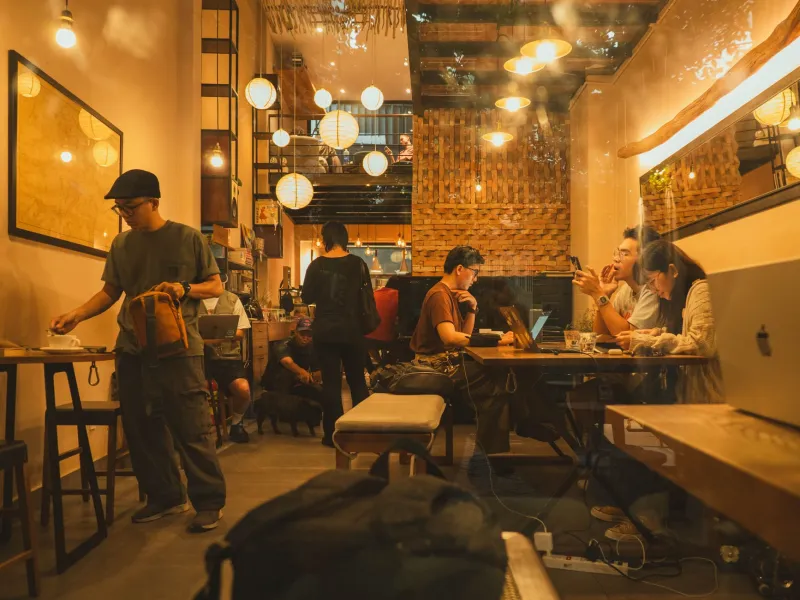
That doesn't mean every café in the city has gone analog. Plenty of spots cater directly to remote workers and students, with long tables, power strips, and fast connections advertised in the window. Taipei is a modern, connected city. The point is that the no-WiFi approach is a conscious choice, not a default — and the cafés that make it tend to know exactly why they're making it.
What Americans Can Actually Take Home
You probably can't replicate this at your local coffee shop back in Denver or Austin. The infrastructure of American café culture — the business model, the customer expectations, the sheer volume of people who need a place to work — makes it a different equation entirely.
But the experience of sitting in a Taipei café without a password, nursing a single-origin pour-over for an hour, talking to a stranger or just watching the street outside, does something to your relationship with the concept of a coffee break. It makes you realize how rarely you actually take one.
The next time you're in Taipei and you can't find the WiFi password, don't ask. Just order another coffee. Something interesting is probably about to happen.