Walls Worth a Thousand Words: The Design Revolution That Remade Taipei's Coffee Shops
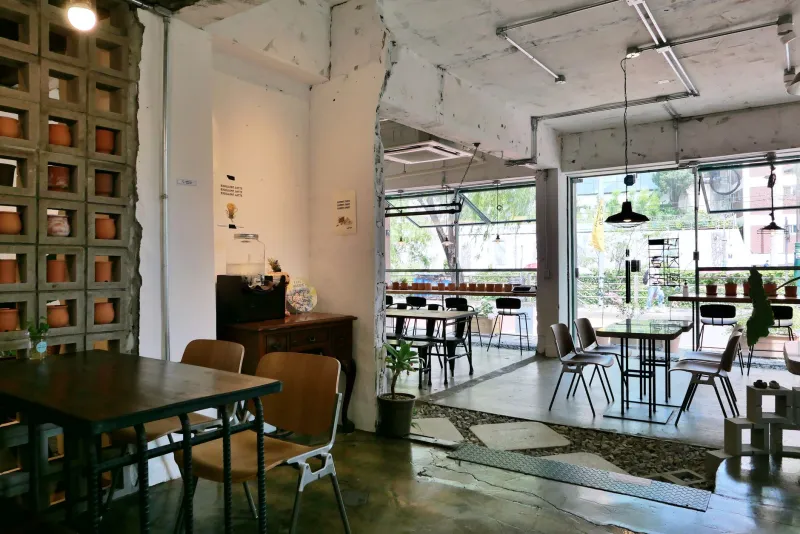
Walk into almost any café in Da'an or Zhongshan these days and you'll notice something that has nothing to do with coffee. Customers spend a solid two or three minutes before ordering just... looking. Tilting their heads. Framing shots. Adjusting the angle of a latte against a concrete wall or a terracotta tile floor. The coffee is almost secondary to the ritual of documenting it.
That wasn't always the case. Not even close.
A Decade Ago, It Was Different
Back in the early 2010s, Taipei's café landscape was split pretty cleanly between two worlds. On one end, you had international chain outposts — familiar, predictable, forgettable in the best way. On the other, you had the convenience store coffee counter: a cup of decent drip pulled from a machine at 7-Eleven or FamilyMart for the equivalent of about a dollar. Both served a purpose. Neither asked anything of you aesthetically.
Then something shifted. A wave of young Taiwanese designers and entrepreneurs, many of whom had studied or traveled abroad, started opening spaces that felt less like coffee shops and more like installations. Japanese minimalism was a huge early influence — clean lines, pale wood, negative space used with almost surgical intention. The idea was that the space itself should communicate something about the quality of what was being served inside it.
"We wanted people to feel calm the moment they walked in," says one café owner in Yongkang who opened her shop in 2014. "In Japan, there's this idea that the environment shapes your experience of food and drink. We borrowed that philosophy pretty directly."
The Instagram Effect: Accelerant or Architect?
It would be easy — and a little lazy — to blame Instagram for everything that followed. But the more accurate story is that Instagram didn't create Taipei's design-forward café culture so much as it poured gasoline on a fire that was already burning.
By 2016 and 2017, photos of Taipei cafés were circulating in ways that designers and owners hadn't anticipated. A particular café in Xinyi with floor-to-ceiling windows and a monochrome palette started appearing in travel roundups across the US, Japan, and Southeast Asia. Suddenly, the visual identity of a café wasn't just a local concern — it was a global calling card.
Interior designers who work in the F&B space in Taipei will tell you that client briefs changed noticeably around this time. "Before, people would say they wanted something comfortable, something that felt like home," recalls one designer who has worked on more than a dozen café spaces across the city. "After Instagram really took off, the language shifted. People started asking for 'moments.' They'd say, 'I want a corner that photographs well.' It became a specific design requirement."
The results ranged from genuinely stunning to, let's be honest, a little cynical. Industrial-chic warehouses in Songshan repurposed old factory bones into soaring, light-drenched spaces that felt earned — like the history of the building was part of the aesthetic conversation. Elsewhere, though, you'd find newly constructed spaces mimicking that worn, vintage look with artificial patina and strategically distressed surfaces. The authenticity question became harder to answer.
The Spaces That Got It Right
What separates the genuinely great café designs from the purely photogenic ones usually comes down to one thing: whether the space actually serves the experience of drinking coffee.
Some of Taipei's most celebrated café interiors work because every design choice connects back to function. Lighting that looks beautiful in photos also happens to be warm and flattering for long work sessions. Seating arrangements that create visual rhythm also give customers a sense of privacy. Counter designs that make for a compelling focal point also allow baristas to interact naturally with guests.
The best café designers in the city talk about this balance almost obsessively. "A space can be gorgeous and still feel wrong," says one designer who has collaborated with several specialty roasters. "If the acoustics are terrible, if the seating is uncomfortable, if the layout makes it hard to have a conversation — people feel that, even if they can't name it. They won't come back."
Repurposed spaces have been particularly successful at threading this needle. Old Japanese-era shophouses in neighborhoods like Dadaocheng carry a texture and character that no amount of interior design budget can manufacture. Cafés that have moved into these buildings and worked with their existing bones — exposed brick, low ceilings, uneven floors — often end up with something that photographs beautifully precisely because it's real.
The Pushback from Coffee Purists
Not everyone in Taipei's coffee community is enthusiastic about the design arms race. Among specialty roasters and serious baristas, there's a persistent undercurrent of frustration with cafés that prioritize aesthetics over craft.
"I've been to places where the espresso machine is basically a prop," says one barista who has competed in national brewing competitions. "It's positioned for photos. The coffee is an afterthought. That bothers me, because it muddies the water for people who are actually trying to do something serious."
This tension isn't unique to Taipei — you'll find versions of it in Melbourne, Seoul, and Brooklyn. But it feels particularly charged here because Taipei's specialty coffee scene has worked hard to build genuine credibility over the past decade. The city's roasters have developed real relationships with farms in Ethiopia, Colombia, and across Asia. Baristas train rigorously. The infrastructure for excellent coffee is real and deep. The worry is that a flood of design-first, coffee-second spaces could dilute the reputation that serious practitioners have spent years building.
Where It Goes From Here
The good news is that the two impulses — beautiful spaces and excellent coffee — don't have to be in opposition. Some of the most exciting cafés opening in Taipei right now are managing both with real confidence. They understand that a thoughtfully designed environment and a well-sourced, expertly prepared cup of coffee are both forms of hospitality. They reinforce each other.
What does seem to be fading, at least in the more design-literate corners of the city, is the purely Instagram-bait approach — the space built entirely around its own photographability, with little thought for what it actually feels like to spend an hour there. Customers are getting more discerning. They've seen enough pretty walls.
The cafés that last in Taipei tend to be the ones that figured out something that good designers have always known: a space that makes people feel genuinely good — comfortable, stimulated, at ease — will always photograph better than one that's merely trying to.