Stay a While: How Taipei's Cafés Are Teaching Americans to Slow Down and Actually Drink Their Coffee
Let me describe a scene that confuses a lot of Americans the first time they encounter it.
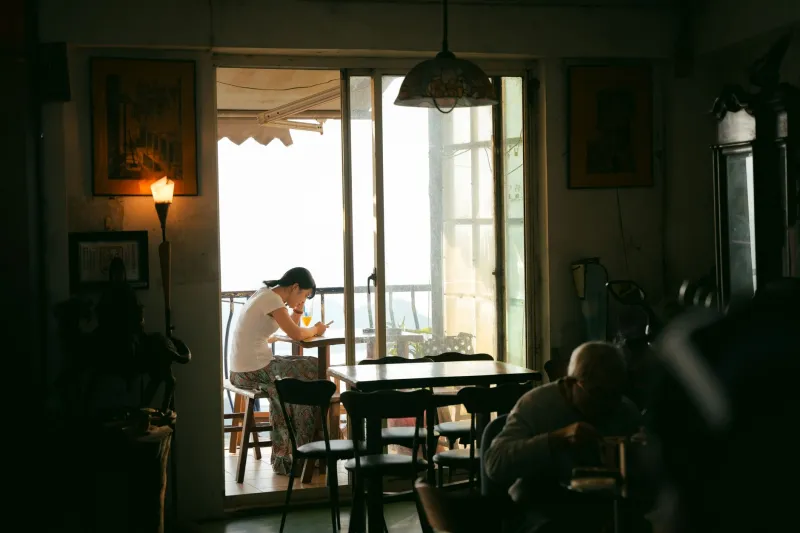
It's a Wednesday afternoon in Taipei. A café in the Yongkang Street area — maybe 20 seats, good natural light, a single barista working the espresso machine with quiet focus. Every table is occupied. People are reading, working on laptops, talking in low voices, staring out the window. Nobody appears to be in any particular hurry. Nobody is eating a sandwich while scrolling their phone with one hand. Nobody is waiting for a to-go cup so they can sprint to a meeting.
The barista brings someone their coffee — a pour-over that took four minutes to make — and sets it down without rushing. The customer doesn't immediately pick it up. They let it cool for a moment. They smell it first.
For a lot of Americans, this scene produces a mild cognitive dissonance. Is this a café or a library? Are these people actually working, or are they just... existing here? And — this is the real question — is that allowed?
In Taipei, not only is it allowed. It's basically the point.
What We Mean When We Say "Third Place"
The sociologist Ray Oldenburg coined the term "third place" back in the 1980s to describe the informal gathering spaces that exist outside of home (the first place) and work (the second place). Barbershops, parks, diners, bookstores. Places where people go not because they have to, but because being there among other people feels good.
The American café was supposed to be a third place. Starbucks literally built its early brand identity around that concept. But somewhere along the way — probably around the time drive-throughs became the dominant format and mobile ordering removed the last reason to actually enter a physical store — the American coffee shop stopped functioning that way for most people. It became a pit stop. A fuel station. Efficient, transactional, and fundamentally about getting out.
Taipei's cafés never made that turn. Or at least, the independent ones didn't. And understanding why tells you something interesting about the city.
The Design Is Doing Something
Walk into a grab-and-go coffee chain and notice how the space is organized. Counters are positioned for throughput. Seating, where it exists, is often uncomfortable by design — hard stools, high tops, awkward angles. The message is: get your coffee, be on your way.
Now walk into a well-regarded independent café in Taipei's Zhongzheng or Xinyi districts. The layout tells a completely different story. Chairs are chosen for actual comfort. Tables are spaced far enough apart that conversations don't bleed into each other. There's usually a mix of seating types — counter seats facing the bar, small tables for two, maybe a low communal table. Lighting is almost always warm and directional rather than overhead fluorescent.
None of this is accidental. Taipei café owners think hard about how space makes people feel, and the goal is consistently to make people feel like they can stay. Some cafés go further — soft background music at a volume low enough that you don't have to raise your voice over it, bookshelves stocked with actual books, plants that create a sense of enclosure without blocking light.
The cumulative effect is that you walk in and your body just... relaxes a little. You're not being moved along. You're being invited to settle.
The Pricing Logic
Here's something that surprises Americans: many Taipei cafés charge what feels like a lot for a single cup of coffee. A specialty pour-over or a carefully made latte might run you NT$180–250, which works out to roughly six to eight US dollars.
That's not cheap by local standards. But consider what you're actually buying. You're not buying a cup of coffee. You're buying a seat in a thoughtfully designed space for as long as you want to occupy it. Most independent cafés in Taipei have no time limit on seating. There's no social pressure to free up the table after an hour. The price of the coffee is, in a sense, the price of admission to that experience.
This reframes the value proposition entirely. Six dollars for a cup of coffee you drink in four minutes on your way to a meeting is expensive. Six dollars for a cup of coffee plus two hours of quiet, comfortable space in a city where real estate is at a premium is actually a pretty reasonable deal.
The Social Norms That Make It Work
The lingering culture in Taipei cafés isn't just a product of design and pricing — it's held in place by a set of unspoken social norms that visitors pick up on quickly.
Loudness is generally not welcome. Not in a hostile way — nobody's going to shush you — but the ambient volume in most independent cafés is low, and people calibrate to it naturally. Phone calls are typically taken outside. Group conversations stay at a conversational level rather than escalating into the kind of performative loudness that can take over a coffee shop in New York or LA.
There's also a notable absence of the guilt loop that many Americans experience when they sit too long in a café. That creeping anxiety — should I buy something else? Is the barista annoyed at me? Should I give up this table? — doesn't seem to operate the same way in Taipei. People order once, sometimes twice, and otherwise just exist in the space without apparent self-consciousness.
For American visitors, breaking that guilt loop is often the hardest part. But once you do, something shifts. You start to actually notice where you are. You look around. You have a conversation that doesn't have an agenda. You finish your coffee before it goes cold because you're not distracted.
What This Looks Like in Practice
Pick a neighborhood café in Taipei — somewhere in Shida, maybe, or the quieter blocks around Dongmen MRT — on a Saturday morning. Get there when it opens. Order something that takes a few minutes to make. Sit somewhere with a window view if you can.
Then don't do anything for a minute. Just watch the barista work. Watch the street outside. Let the coffee cool to the right temperature. Notice what's on the walls. Listen to whatever's playing at low volume.
This is the experience that Taipei's café culture is optimized for, and it's genuinely different from what most Americans encounter at home. It's not about productivity or efficiency or even necessarily the coffee itself. It's about having a place to be that isn't home and isn't work, where the baseline expectation is that you're there to be present rather than to accomplish something.
The Thing We Could Learn
American coffee culture has a lot going for it. Specialty coffee in cities like Portland, Chicago, and New York has gotten genuinely excellent. The craft is there. What's often missing is the philosophy around it — the idea that the café itself, not just the product it sells, has value worth protecting.
Taipei's independent cafés have figured out something that's easy to overlook: slowing people down is a feature, not a bug. A customer who lingers for two hours and orders one thing is not a problem to be optimized away. They're the whole point.
You don't have to move to Taipei to apply this. But spending a few mornings in its cafés might permanently change your relationship with the concept of a coffee break. Less break, more arrival. Less fuel stop, more somewhere to actually be.
That's worth the price of a pour-over.